Signed in as:
filler@godaddy.com
Signed in as:
filler@godaddy.com

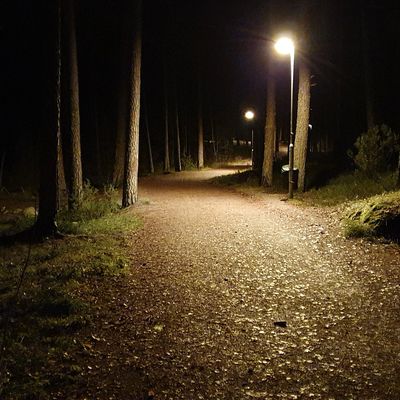
The research has been conducted at the NorDark sites and has explored pedestrian experiences in daylight and electric lighting scenarios with pole-mounted luminaires in Uppsala and wearable head torches in Ålesund. At both locations people residing in the area were invited to walk a local forest path and assess their experiences in a structured way regarding amongst others the visual accessibility of the environment, perceived safety, perceived lighting quality, and the environments potential to facilitate psychological restoration. These experiences are considered important for people’s walking intentions. A special interest has been to analyse the residents’ experiences of the new lighting scenarios designed by the KTH team. Moreover, the digital twin developed by the NTNU team has been used to investigate the effect of snow cover in an experimental laboratory study.
While most of the environmental experiences investigated deteriorate from daylight to electric lighting, we find that assessments of the potential for psychological restoration brought about by the urban forests to some extent remains in electric lighting after dark. Our results suggest that a pole-mounted lighting scenario using amber lighting in the periphery is assessed similar to current standard lighting from the pedestrian perspective with regard to accessibility and safety. In addition this lighting scenario is also being perceived as more comfortable. In a lighting scenario combining amber light with a substantial reduction of the light output (to 11%), the environmental experiences were assessed significantly lower, which was also the case for the potential for psychological restoration. However, at regular light output the lighting scenario with white and amber light seemed to be functional for humans, while likely reducing the impact on non-human species through the use of amber lighting.
In Ålesund a comparison was made between residents walking along an urban forest path in daylight and residents walking after dark wearing either an off-the-shelf head torch or a customized head torch. The results suggest that wearable lighting can provide sufficient illumination to support pedestrian use of urban forests after dark and that the customized head torch designed to have a lower ecological impact was assessed similarly to the off-the-shelf head torch.
Further, an analysis of the participants’ self-reported psychological restoration from participating in the forest walks revealed that some electric lighting conditions may support restoration after dark.
In the experimental study involving the digital twin, a positive effect of snow cover was identified for the environmental experiences under electric light conditions after dark.
The environmental psychology results contribute to the understanding of how electric lighting scenarios can be adapted to provide environmental experiences supporting local residents’ opportunities for forest walks while at the same time minimizing negative ecological effects.